
How should ROUND LAB CICA ingredients be read?
CICA is not a single official ingredient name. It commonly refers to Centella asiatica and several components associated with the plant. Read the individual names on the ingredient list instead of relying on CICA alone.
The names below are examples of CICA-related labels. Check which ingredients are actually included on the full ingredient list of the product you buy.
Centella Asiatica Extract is used as a skin-conditioning ingredient. Asiaticoside and Asiatic Acid are also skin-conditioning ingredients. Madecassoside and Madecassic Acid have the same formulation purpose but separate listed names.
Pinus Densiflora Leaf Extract is an example of a pine-derived ingredient name, used as a moisturizing ingredient. The botanical name is usually used on an English ingredient list. A reference to pine in the product name does not state which pine ingredient is used or how much.
Korean skincare formulas may combine botanical extracts with familiar humectants. A range name alone does not establish concentration or texture.
Reading humectants and clays in order
Begin near the top of the ingredient list, especially after water. Ingredients are generally listed in descending order, while those at 1% or less may appear in another order. Position alone cannot reveal an exact concentration.
Glycerin is a humectant used to retain moisture. Propanediol and Butylene Glycol are also included for moisturizing purposes. These ingredients are used in fluid toner and lotion formulas.
Hyaluronic Acid, Hydrolyzed Hyaluronic Acid, and Sodium Hyaluronate are separate names for moisturizing ingredients. Korean formulas may combine several of them in one product. Several names do not mean that a larger application is required.
Kaolin is an absorbent clay used in clay packs. Bentonite and Montmorillonite belong to the same broad ingredient category. They appear in rinse-off products.
Why Korean and Japanese product terms differ
A Korean toner is generally called a lotion or face lotion in Japan. A Korean lotion is closer to a Japanese emulsion. This difference matters because the English word lotion can describe either category.
Cream has a similar meaning in both markets. The Korean term pack covers sheet masks and rinse-off masks. A clay pack is applied after cleansing and removed with water.
Read the product name, format, and complete ingredient list in that order. Consider the positions of humectants and absorbents instead of choosing by CICA alone. After purchase, read the full list on the box or container from the top.
Amounts and layering order
The standard order is cleanser, toner, lotion, and cream. In the morning, sunscreen follows skincare and comes before makeup. Use a clay pack after cleansing but before toner.
- Press toner over the face.
- Apply lotion, starting on areas that dry out easily.
- Spread a thin layer of cream, beginning on the cheeks.
- In the morning, let it settle before applying sunscreen and makeup.
Follow each product’s label for amounts and frequency. Add small amounts of cream to areas that feel dry. Do not layer cream on areas that feel sticky.
Follow the label for how often to use a clay pack and how long to leave it on. Do not leave it on beyond the stated time.
During seasonal changes, avoid introducing several products together. Add one item at a time, such as toner, and check how it feels.
Precautions
It is common to test a new product with a small amount on the inner arm. Check that no redness or itching appears before applying it to the face. Stop using it if redness, swelling, itching, irritation, or any other unusual reaction occurs.
Keep a clay pack away from the eyes and mouth. Do not leave it on until it becomes excessively dry, and rinse within the stated time. Consult a dermatologist if an unusual skin reaction continues.
Product examples for reading the range
Formats within the same Pine Calming CICA range occupy different routine steps. Toner, lotion, and cream follow the moisturizing order. The clay pack is rinsed off before leave-on skincare.
| Product name | Size |
|---|---|
| For Men Pine Calming CICA Toner Large Size | 300ml |
| For Men Pine Calming CICA Lotion Large Size | 300ml |
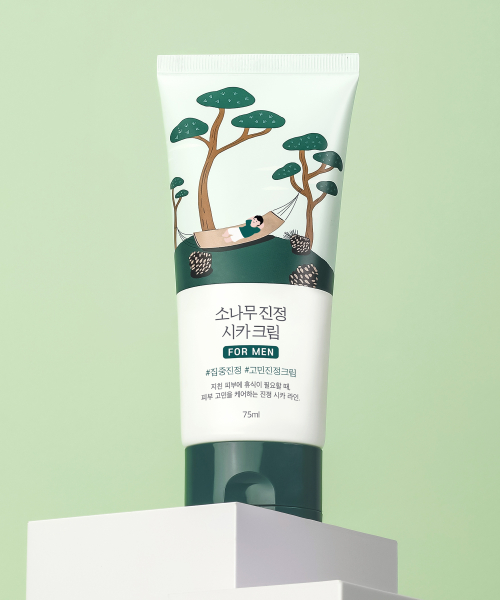
| For Men Pine Calming CICA Cream | 75ml |
| For Men Pine Calming CICA Clay Pack | 100ml |
Treat toner as the watery first step and lotion as an emulsion. Cream belongs near the end of a routine to replenish and maintain the skin’s moisture and oils. The clay pack should be considered separately from daily leave-on moisturizers.
Frequently asked questions
Is CICA the same as Centella Asiatica Extract?
Not exactly. CICA is a range term that can cover Centella Asiatica Extract and related ingredients such as Asiaticoside. Read each formal name on the complete ingredient list to understand what the formula actually contains.
Does toner go before lotion?
Yes. Apply toner first, followed by the Korean-style lotion, which functions more like an emulsion. In a morning routine, apply cream if needed, then sunscreen, and finally makeup.
Can a clay pack be used every day?
Follow the product label for frequency. Do not leave it on longer or use it more often than the label states. Follow with lotion or cream afterward.
Can women use a product labeled for men?
A gender label does not prevent use by another gender. Base the decision on format, ingredients, and how the product feels on the skin. Avoid use when skin feels sensitive, such as right after shaving.
Summary
- CICA is a range term for Centella-related ingredients, not one ingredient.
- Toner is the watery step, while a Korean lotion is closer to an emulsion.
- Follow each product’s label for amounts and frequency.
- Use a clay pack after cleansing and rinse it away within the stated time.